For Real Estate

Construction & portfolios: in control

New build, refurbishment, property management or portfolio transactions: real estate projects run long with many trades. PathHub AI structures your project.

Start Free See features
Context

What matters in real estate projects

Construction and renovation projects follow fixed work stages with many parties.

9
HOAI work stages, each with its own parties and deliverables.
Source: § 34 HOAI 2021
Gewerke
Many trades and subcontractors must be scheduled in the right order.
Abnahme
Acceptance and defect management decide on dates and warranty.
Nachweise
Energy and sustainability evidence (e.g. GEG, DGNB) needs planning from the start.
Challenges

Typical hurdles in Real Estate projects

1

Many trades

Architecture, structural, MEP, fit-out, landscaping: all must run in sync or the site stops.

2

Approvals

Building permit, heritage, fire safety: long waiting times to plan for, or everything shifts.

3

Budget control

Cost control amid volatile material and labour prices, change order management, overrun risk.

4

Sustainability

ESG, green finance, EU Taxonomy, CSRD: rising green requirements impact cost.

Lifecycle

Construction project lifecycle

From preparation to handover: typical project stages at a glance.

Phase 1: Basics
Demand, location
→
Phase 2: Pre-design
Concept
→
Phase 3: Design
Architect
→
Phase 4: Permitting
Building permit
→
Phase 5: Construction Doc
Detail plans
→
Phase 6: Tendering Prep
BoQ
→
Phase 7: Tendering
Awarding
→
Phase 8: Site Supervision
Construction
→
Phase 9: Aftercare
Warranty
Cross-cutting: Fire safety · Sustainability (CSRD) · Change orders · HSE
Solution

How PathHub AI helps in Real Estate

1

Trade choreography

Phase and milestone logic aligned with project stages, dependencies between trades modelled automatically.

2

Approval buffers

Waiting times for authorities auto-included as risk + buffer: no nasty surprises on permits.

3

Budget discipline

Line-item budget, actuals per trade, variance alerts above 5% over plan.

4

ESG reporting

Sustainability KPIs captured and report-ready for CSRD and EU Taxonomy.

Use Cases

Three Real Estate Scenarios

From new build to renovation project: HOAI-compliant phase structures.

Residential Build (>20 units)

9 HOAI phases automatically. Stakeholders (builder, architect, MEP planner, specialist), compliance (LBO, GEG, DIN), risks (soil, permitting, subcontractors).

→ 60 % faster setup phase
Commercial Renovation (existing)

Stock assessment, hazmat survey, permitting on existing. Compliance: GEG, workplace regs, fire protection.

→ Clear separation existing/new
Quarter Development (Mixed-Use)

Parallel residential + commercial + open spaces. Multi-stakeholder (investor, city, residents). AI detects conflict points.

→ Risk early warning +18 mo.
Example

What the AI creates from a project brief

Example: Refurbishment of a commercial property

You write: “Full refurb of 5,000 sqm office, green building certification (DGNB Gold), 18 months.”

Detected stakeholders

OwnerArchitectStructural engineerMEP plannerFire safety officerHSEConstruction managerTrades (15+)Heritage (if applicable)

Detected compliance requirements

Building codeFire safety proofDGNB / LEEDCSRDEU TaxonomyHSE / safety plan

Detected risks

Permit delayGround finds / contaminationChange ordersMaterial shortagesWeather risk

Generated project phases

1
Phase 1: Basics

Demand clarification, location research, scope of work, target agreement

2-4 wk.
2
Phase 2: Pre-design

Concept, variant studies, mass calculation, cost estimate per DIN 276

4-8 wk.
3
Phase 3: Design

Detailed design, construction planning, cost calculation, authority pre-talks

8-12 wk.
4
Phase 4: Permitting

Building application, structural proof, fire protection, energy certificate, negotiations

3-6 mo.
5
Phase 5: Construction Documents

Workshop and detail drawings, construction blueprints, material specs

8-16 wk.
6
Phase 6: Tendering Preparation

Bill of quantities, tender documents, bidder talks

4-8 wk.
7
Phase 7: Tendering

Bid analysis, negotiation, contract award

4-8 wk.
8
Phase 8: Site Supervision

Construction management, quality, deadlines, cost control, acceptance

6-24 mo.
9
Phase 9: Aftercare

Warranty, defect management, documentation, final invoicing

5 years
Real sample plan

What the plan looks like in PathHub

PathHub created this plan from a short description: “Deep renovation of a 5,000 m² office building including DGNB Gold green-building certification, running for 18 months.” Result: 10 phases, 81 tasks, 9 risks and 3 compliance items.

Schedule with 10 phases

The whole plan at a glance, phases may overlap. The Plan tab expands every task.
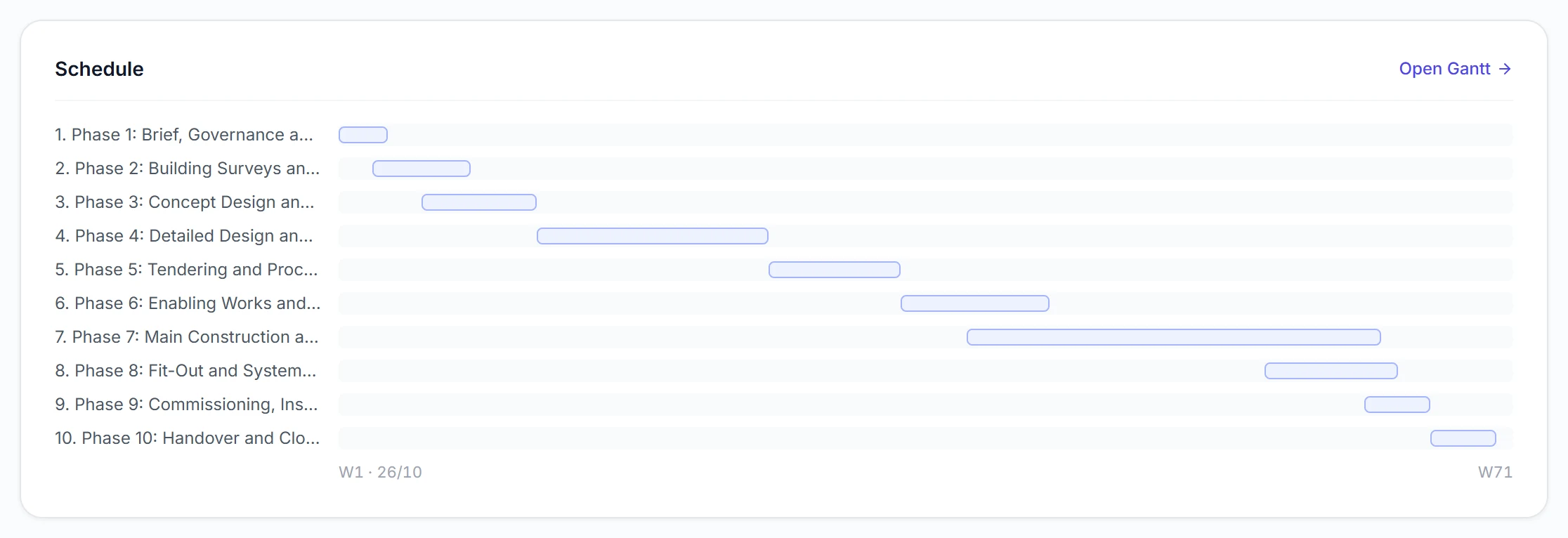
Schedule with 10 phases – Deep renovation of an office building with DGNB Gold

Obligations for this initiative

Legal and industry requirements, each with owner and timing in the plan.
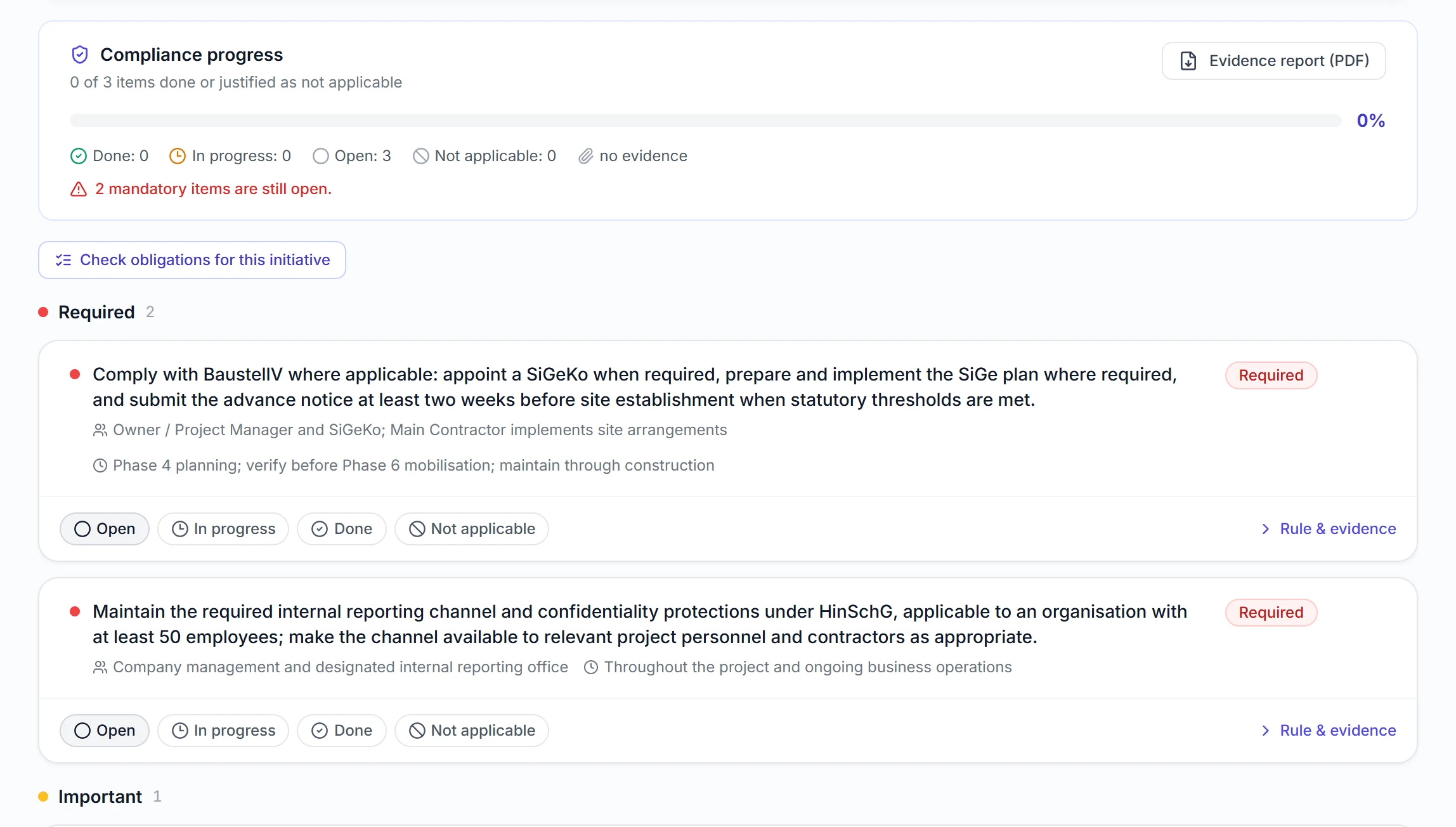
Obligations for this initiative – Deep renovation of an office building with DGNB Gold

Risks with mitigations

Rated by impact, each with a concrete mitigation.
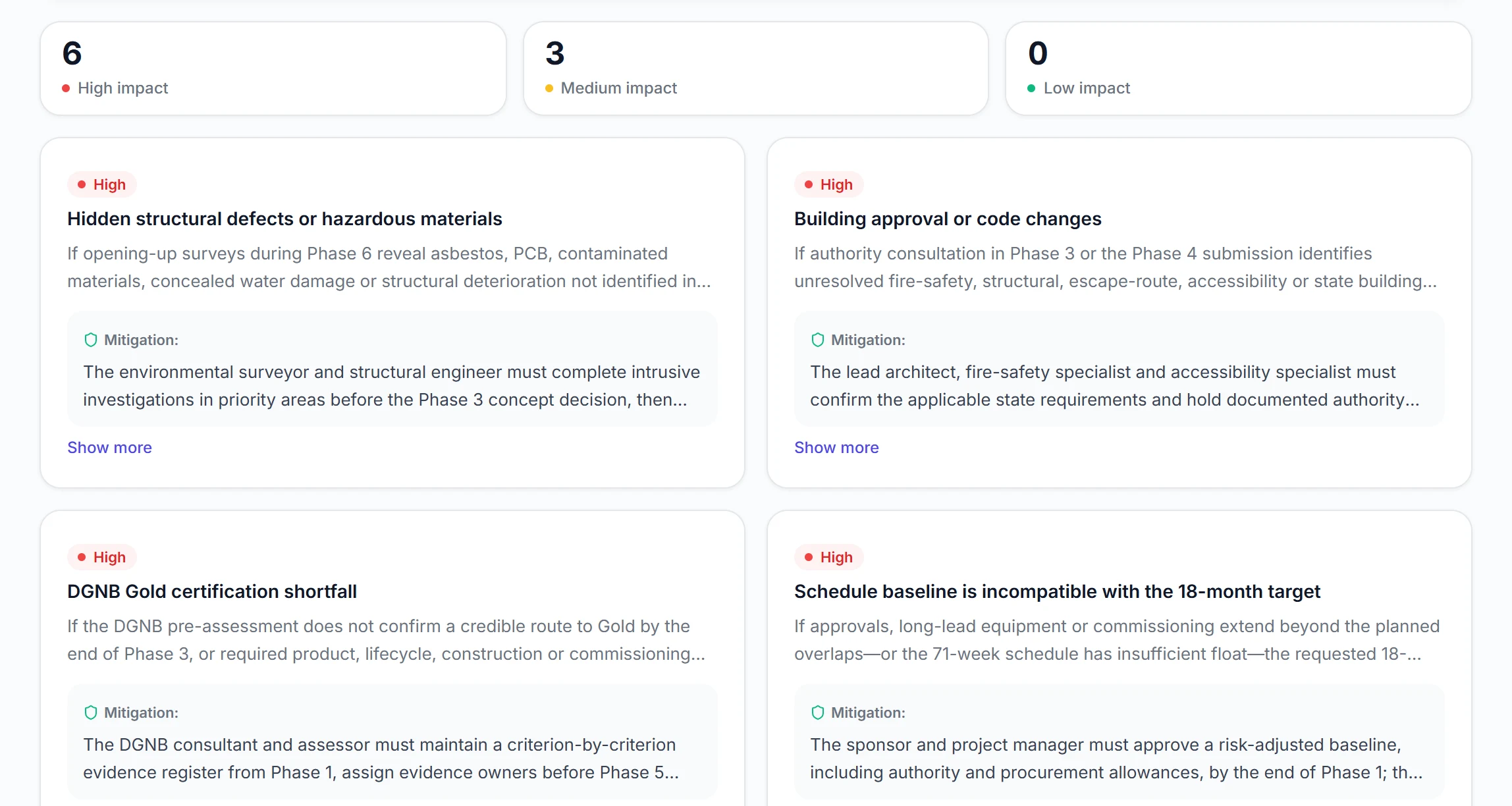
Risks with mitigations – Deep renovation of an office building with DGNB Gold

Stakeholders

Roles with their responsibility and the phase from which they are needed.
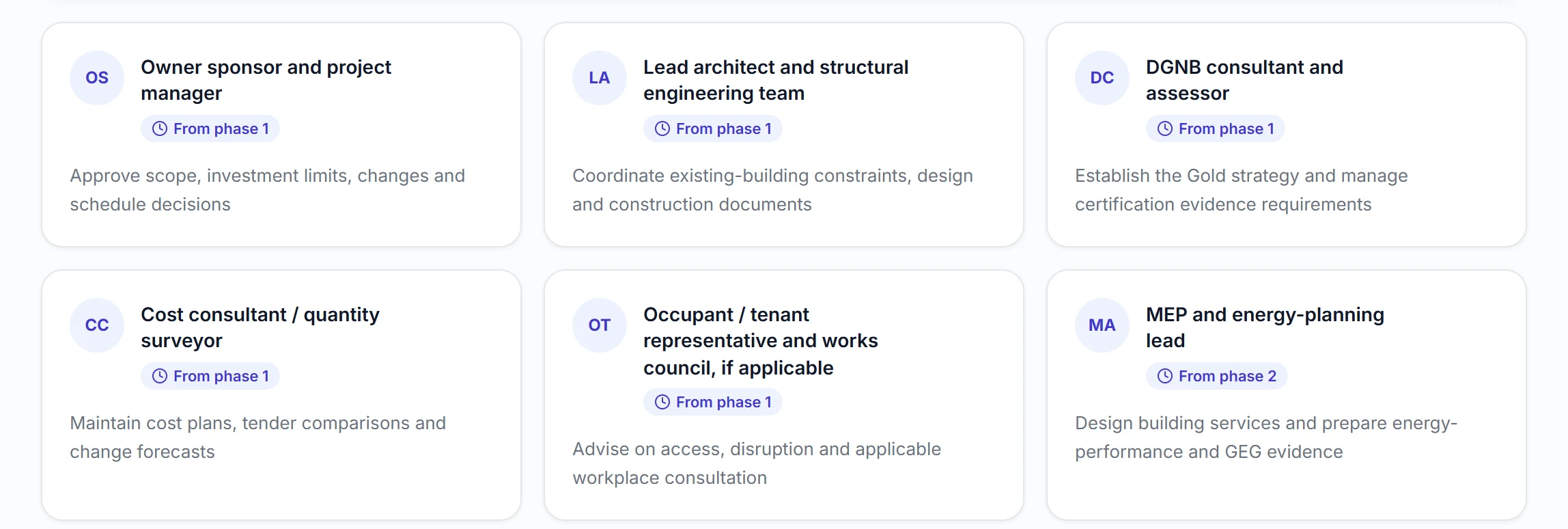
Stakeholders – Deep renovation of an office building with DGNB Gold

Unedited plan, created with PathHub on 23 Oct 2026. Views shortened. Create your own plan →

Features

Relevant features for Real Estate

Stage-based phase structure
Compliance check for building, fire, green finance
Detailed budget items per trade
Risk matrix for permits & costs
Stakeholder map for authorities & partners
PDF export for owner reports
ESG KPIs captured automatically
AI recommendations on change order risks
Comparison

PathHub AI vs. classic PM tools for Real Estate Projects

What classic tools can do, and where they hit limits in your day-to-day.

FeatureAsanaTrelloClickUpPathHub AI
AI project plan from 3 sentences——Limited✓
Industry-specific compliance detection———✓
Multi-workspace per project/client✓Boards✓✓
Detailed budget positions + actual trackingvia Add-on—Basics✓
Auto stakeholder detection———✓
Weekly status agent———✓
PDF export for reportsBasic—✓✓
GDPR-compliant + EU hostingUS-CloudUS-CloudUS-Cloud✓ DE
HOAI-compliant service phases (1-9)———✓
Example

An example from everyday work

„On a refurbishment with 15 trades in parallel, PathHub's stakeholder map shows us who to involve when, and reminds of HSE and fire safety early.“

Example: Project controller, property developer

This is how feedback from everyday work could sound.

FAQ

Frequently asked questions

Yes, for building / existing projects the AI auto-generates the 9 phases per HOAI 2021 §34. Includes typical tasks per phase, involved specialists (statics, MEP, fire) and phase-specific risks.
Typical: GEG (energy), state building code (LBO), DIN 18040 (barrier-free), fire protection proof, sound insulation, workplace regs, VOB, BauGB. Context-specific by use (residential/commercial/industrial).
Own phase 'permitting' with sub-tasks (building application, structural proof, fire, energy certificate) and risk 'authority kickback'. Stakeholder building authority + EIA where applicable are detected.
Yes: PDF with project-specific layout, no internal pricing details. Includes status, cashflow, critical path, open permits, risk heatmap.
Yes. Subsidy applications are scheduled as own phase including documentation duties and deadlines. Risk 'subsidy repayment on non-compliance' is flagged.
Yes. Per trade (shell, drywall, MEP, facade) own tasks are generated. Status, deadlines, defects, acceptance per trade. PDF export per subcontractor possible.
Clear phase separation. At phase 9 start, automatic reminder of warranty periods (4 yr defect liability, 30 yr fraudulent concealment). Defect management as sub-workflow.
Yes, especially there, because there's rarely a project steerer. Free plan covers 1 project, Pro 3 parallel. Includes HOAI templates per building class.
More industries

Other industries that fit

Plan your next real estate project

Try PathHub AI free. No credit card, your first Path in just a few minutes.

Start Free →